
Geko Fitting Demo: Simplified Usage#
This notebook demonstrates how to use geko to fit JWST grism spectroscopy data using a simple Python interface.
Overview#
geko is a Python package for analyzing JWST grism spectroscopy and morphology data. It uses:
JAX for accelerated numerical computation
Numpyro for Bayesian inference via MCMC
Kinematic models to fit galaxy rotation curves
Required Data Structure#
All data files should be organized in a single base directory (specified by save_runs_path). The code expects the following structure:
Directory Structure#
<save_runs_path>/                     # Base directory (e.g., 'fitting_results/')
├── <output_name>/                    # Subfolder for your specific galaxy/run
│   ├── <grism_file>.fits             # 2D grism spectrum (required)
│   └── <ID>_output                   # Fit results (generated after run)
├── morph_fits/                       # Morphology results directory
│   └── <pysersic_file>.cat           # PySersic Sersic profile fits
├── psfs/                             # PSF files directory
│   └── <your_psf>.fits               # Your PSF file
└── catalogs/                         # Optional: catalog directory
    └── <master_catalog>.cat          # Master catalog (can be anywhere)
Example: If you set:
save_runs_path='/path/to/data/'output_name='my_galaxy'source_id=12345manual_grism_file='my_grism_spectrum.fits'manual_psf_name='my_psf.fits'manual_pysersic_file='my_morphology.cat'manual_theta_rot=45.0
The code will look for:
Grism spectrum:
/path/to/data/my_galaxy/my_grism_spectrum.fitsMorphology:
/path/to/data/morph_fits/my_morphology.catPSF:
/path/to/data/psfs/my_psf.fitsRotation angle: 45.0 degrees
Results saved to:
/path/to/data/my_galaxy/12345_output
Required Files#
1. Master Catalog File#
An ASCII table containing source properties. Path specified as master_cat parameter (can be located anywhere).
Required columns:
ID: Source identifier (must match yoursource_id)zspec: Spectroscopic redshift<line>_lambda: Observed wavelength of emission line (e.g.,H_alpha_lambdafor H-alpha at 6562.8 Å)fit_flux_cgs: Log of integrated emission line flux (log erg/s/cm²)fit_flux_cgs_e: Error on log flux
2. Grism Spectrum FITS File#
Located at: <save_runs_path>/<output_name>/<grism_file>.fits
Specify your filename via manual_grism_file parameter.
FITS File Structure:
The grism spectrum FITS file must contain the following extensions and headers:
Extension 0 (Primary Header):
Header:
RA0- Right ascension of target (degrees)Header:
DEC0- Declination of target (degrees)
Extension ‘SPEC2D’ (2D Spectrum):
Data: 2D array of flux values (spatial position × wavelength)
Header:
WAVE_1- Wavelength of first pixel (microns)Header:
D_WAVE- Wavelength step per pixel (microns)Header:
NAXIS1- Number of wavelength pixelsHeader:
NAXIS2- Number of spatial pixels
Extension ‘WHT2D’ (Weight/Error Map):
Data: 2D array of inverse variance weights (1/σ²)
Same dimensions as SPEC2D extension
Extension 5 (Grism Configuration Table):
Column:
module- Array of NIRCam module identifiers (‘A’ or ‘B’)Column:
pupil- Array of grism pupil identifiers (‘R’ for row dispersion, ‘C’ for column dispersion)
Note: Only pupil='R' (row dispersion) is currently supported. The code will raise an error if pupil='C' is detected. Module B data is automatically handled by flipping the spectrum along the wavelength axis.
3. PySersic Morphology File#
Located at: <save_runs_path>/morph_fits/<pysersic_file>.cat
Specify your filename via manual_pysersic_file parameter.
ASCII catalog from PySersic fits containing:
Sersic index (n)
Effective radius (r_eff)
Position angle (PA)
Axis ratio (q)
Centroid positions (x0, y0)
These morphological parameters are used to set priors for the kinematic fitting.
4. PSF File#
Located at: <save_runs_path>/psfs/<psf_file>.fits
Specify your filename via manual_psf_name parameter.
Point spread function FITS file for your grism observations.
5. Rotation Angle (theta)#
The rotation angle aligns the morphological model (from imaging) with the grism orientation. Specify via manual_theta_rot parameter (in degrees).
Field Options#
The recommended mode is field='manual', which allows you to specify custom file paths for all inputs.
Predefined fields are also available for specific JWST programs (GOODS-N, GOODS-N-CONGRESS, GOODS-S-FRESCO), which automatically select PSF files, rotation angles, and file naming conventions. These are primarily for internal use with specific survey data.
Running the Fit#
Once you have prepared all required files, running the fit is straightforward:
# Import required modules
from geko.fitting import run_geko_fit
from geko.config import FitConfiguration

# JAX configuration
import jax
jax.config.update('jax_enable_x64', True)

print("Imports successful!")
Imports successful!
Basic Usage#
#load the geko folder path
# geko_path = '/path/to/geko/'  # Change this to your geko folder path
geko_path = '/Users/lola/geko/'  # Change this to your geko folder path
# Define parameters
source_id = 191250                      # Source ID in your catalog
field = 'manual'                        # Field name: use 'manual' to specify custom files
output_name = 'my_galaxy'              # Name of output folder
master_catalog = geko_path + 'demo/simple_fit_demo_files/catalogs/my_galaxies_cat'  # Path to master catalog
emission_line = 'H_alpha'                   # Emission line wavelength (Angstroms, rest frame)
parametric = True                      # Use parametric Sersic morphology
save_runs_path = geko_path + 'demo/simple_fit_demo_files/'    # Where to save results

# Manual field parameters (required when field='manual')
manual_psf_name = 'webbPSF_F444W.fits'           # PSF filename in psfs/ directory #this is the simple PSF generated with webbpsf,
                                                 # users can ues their own PSF which is most accurate for their data
manual_theta_rot = 0.0                                     # Rotation angle in degrees (GOODS-S value)
manual_pysersic_file = 'summary_191250_image_F150W_svi.cat'  # PySersic file in morph_fits/
manual_grism_file = 'spec_2d_FRESCO_F444W_ID191250_comb.fits'  # Grism spectrum in output/ directory

# Optional parameters (with defaults)
grism_filter = 'F444W'                 # Grism filter
delta_wave_cutoff = 0.02             # Wavelength bin size (microns)
factor = 1                             # Spatial oversampling factor (set low for demo speed- typically 5)
wave_factor = 1                       # Wavelength oversampling factor (set low for demo speed- typically 9)
model_name = 'Disk'                    # Kinematic model type

# MCMC parameters
num_chains = 1                       # Number of MCMC chains
num_warmup = 100                       # Warmup iterations
num_samples = 100
                     # Sampling iterations
# Run the fit with manual field option
inference_data = run_geko_fit(
    output=output_name,
    master_cat=master_catalog,
    line=emission_line,
    parametric=parametric,
    save_runs_path=save_runs_path,
    num_chains=num_chains,
    num_warmup=num_warmup,
    num_samples=num_samples,
    source_id=source_id,
    field=field,                        # 'manual' mode
    grism_filter=grism_filter,
    delta_wave_cutoff=delta_wave_cutoff,
    factor=factor,
    wave_factor=wave_factor,
    model_name=model_name,
    config=None,                        # Optional: custom configuration
    # Manual field parameters (required when field='manual')
    manual_psf_name=manual_psf_name,
    manual_theta_rot=manual_theta_rot,
    manual_pysersic_file=manual_pysersic_file,
    manual_grism_file=manual_grism_file
)
Cont sub done
Flipping map! (Mod B)
(15, 15)
Module B detected: Flipping dispersion coefficient b01 from -1018.1000 to 1018.1000
Disk model created
Disk object created
Rotating the prior by  0.0  radians, from  2.964  radians to  2.964  radians
Setting parametric priors:  10.175309523224001 59.206811076802936 3.342 1.297 0.18970094750436658 15.165 15.0425
MCMC settings: 1 chains, 100 samples, 50 warmup, max_tree_depth=10, target_accept=0.8
step size:  0.1
warmup:  50
samples:  100
sample: 100%|██████████| 150/150 [03:09<00:00, 1.26s/it, 31 steps of size 1.22e-01. acc. prob=0.92]
done

                          mean       std    median      5.0%     95.0%     n_eff     r_hat
         unscaled_PA     -2.56      0.80     -2.62     -3.67     -1.30    101.74      0.99
   unscaled_PA_morph      0.06      0.95      0.01     -1.24      1.78     51.77      0.99
         unscaled_Va      0.71      0.03      0.71      0.67      0.77     14.62      0.99
  unscaled_amplitude      0.81      0.05      0.81      0.76      0.89     82.62      0.99
          unscaled_i      1.76      0.83      1.76      0.30      3.02    177.35      0.99
          unscaled_n     -0.92      0.01     -0.92     -0.94     -0.90    108.61      0.99
      unscaled_r_eff      0.82      0.04      0.82      0.76      0.87     56.46      1.01
        unscaled_r_t      0.63      0.16      0.60      0.43      0.90     13.84      1.00
     unscaled_sigma0      0.03      0.03      0.03      0.00      0.07     77.69      0.99
         unscaled_v0     -1.24      0.56     -1.25     -2.02     -0.36     61.91      0.99
     unscaled_x0_vel     -1.96      0.54     -1.96     -2.84     -1.11     58.10      1.01
   unscaled_xc_morph      0.52      0.47      0.54     -0.24      1.18     84.56      0.99
     unscaled_y0_vel     -0.35      0.40     -0.30     -0.88      0.41    123.32      0.99
   unscaled_yc_morph      1.09      0.16      1.10      0.83      1.32    144.98      0.99

Number of divergences: 0
Cont sub done
Flipping map! (Mod B)
(15, 15)
Module B detected: Flipping dispersion coefficient b01 from -1018.1000 to 1018.1000
Disk model created
Disk object created
<Figure size 1000x1000 with 0 Axes>
Understanding the Output#
After the fit completes, geko saves several output files in the directory:
<save_runs_path>/<output_name>/
All output files are named using the source ID, not the folder name. This allows you to use any folder name (like ‘my_galaxy’) while keeping files organized by source ID.
Output Files#
<source_id>_output(NetCDF file)Contains the full MCMC posterior samples and prior samples
Can be loaded with
arviz.InferenceData.from_netcdf()Includes all fitted parameters: Va, sigma0, PA, inc, r_eff, n, xc, yc, amplitude
<source_id>_results(ASCII table)Summary statistics for all fitted parameters
Contains median values and 16th/84th percentiles (1-sigma uncertainties)
Includes derived quantities like v_re (velocity at effective radius)
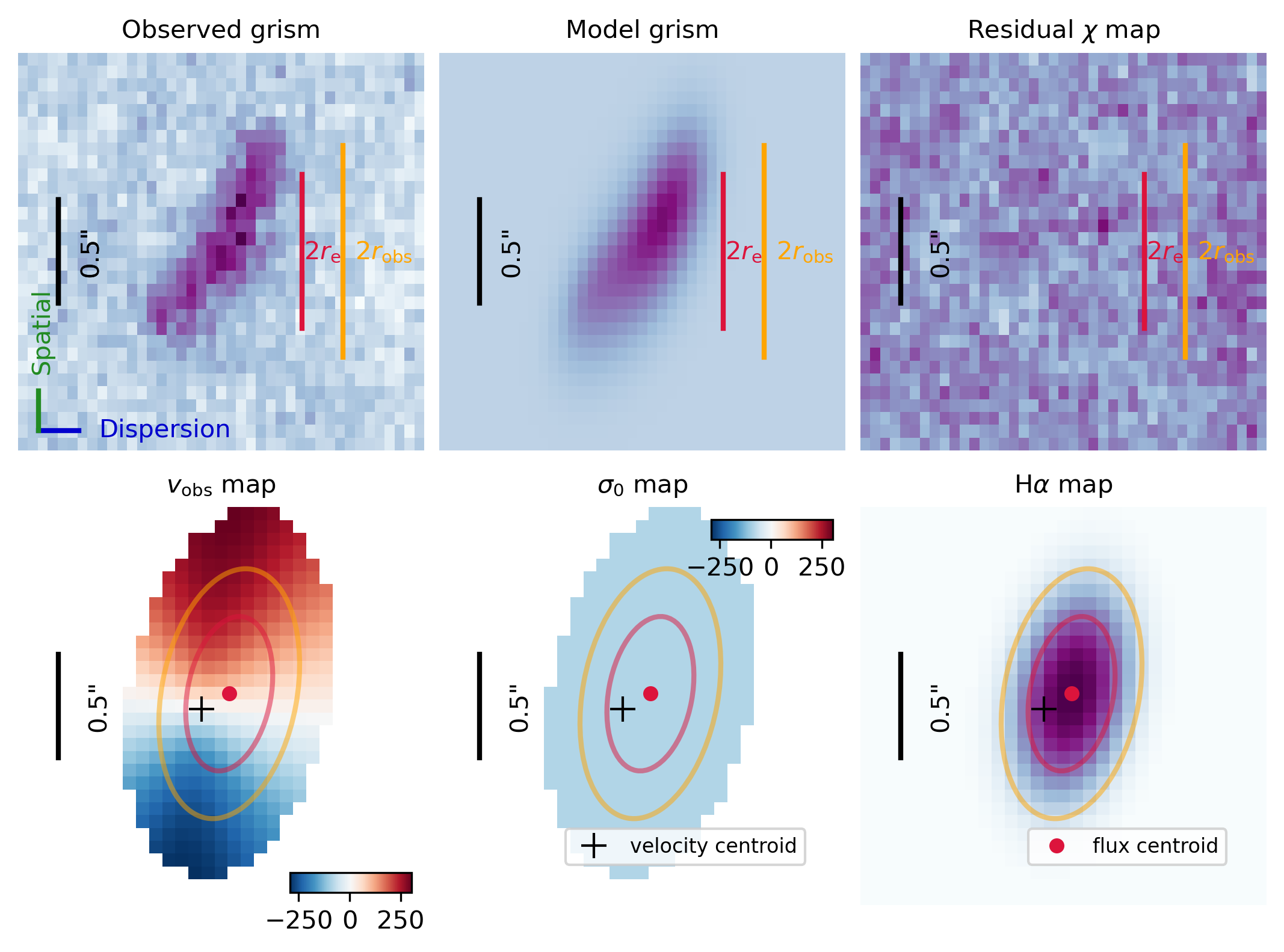
<source_id>_summary.png(Diagnostic plot)Multi-panel figure showing:
Observed 2D spectrum
Best-fit model spectrum
Residuals (observed - model)
1D velocity and dispersion profiles
Rotation curve and fit parameters
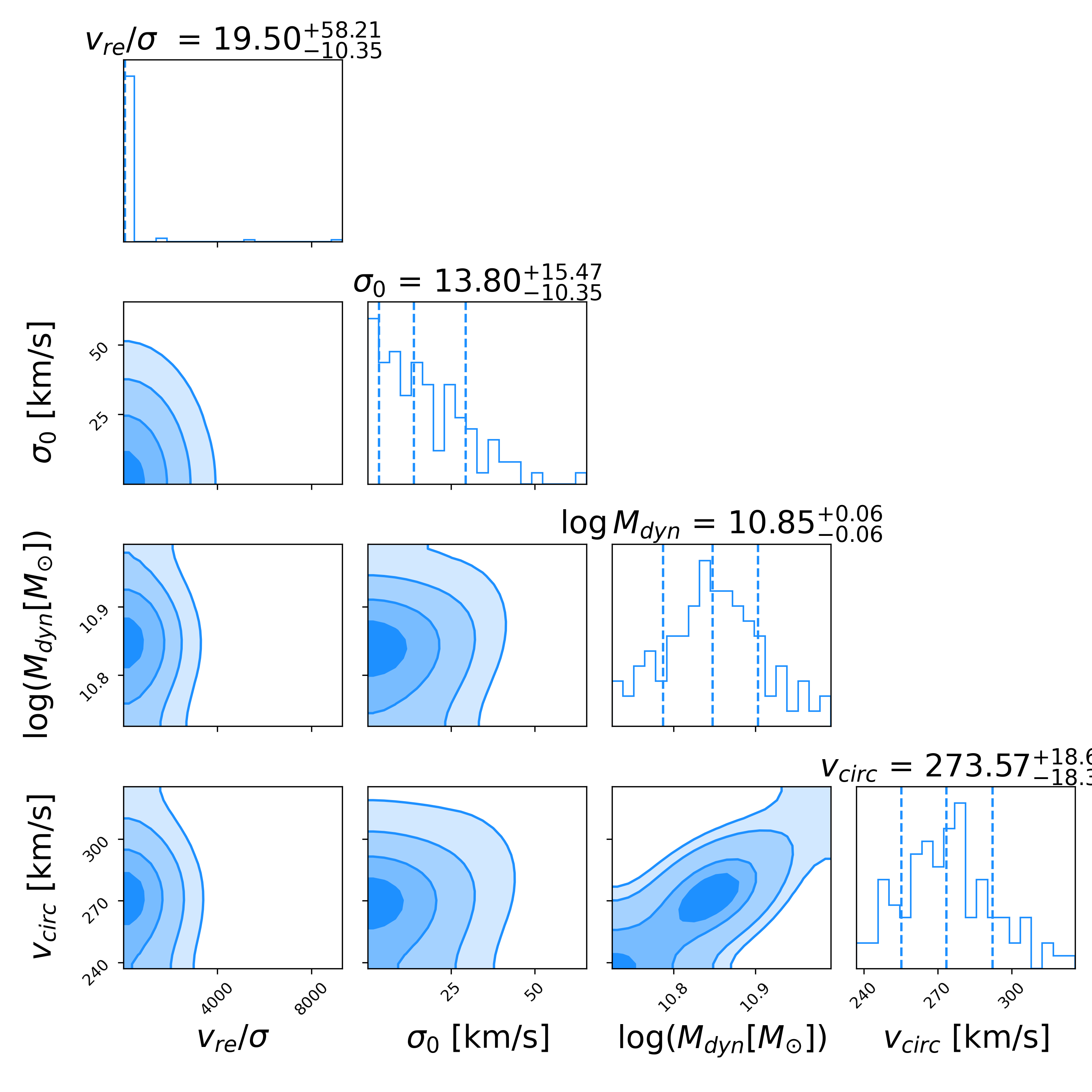
<source_id>_v_sigma_corner.png(Corner plot)Posterior distributions for v/σ ratio
Shows correlations between velocity and dispersion
Let’s load and examine these outputs:
import arviz as az
import matplotlib.pyplot as plt
from IPython.display import Image, display
import os

# Construct output directory path
output_dir = os.path.join(save_runs_path, output_name)
# Load and display the fit results table
import numpy as np
from astropy.table import Table

fit_results_file = os.path.join(output_dir, f'{source_id}_results')
if os.path.exists(fit_results_file):
    fit_results = Table.read(fit_results_file, format='ascii')
    print("\n" + "=" * 60)
    print("Fit Results Summary")
    print("=" * 60)
    print(fit_results)
else:
    print(f"Fit results file not found: {fit_results_file}")
============================================================
Fit Results Summary
============================================================
   ID          PA_50       ...        n_16               n_84
-------- ----------------- ... ------------------ ------------------
191250.0 6.118682355483754 ... 0.3643496813422901 0.3896656002745919
# Display the summary diagnostic plot
summary_plot = os.path.join(output_dir, f'{source_id}_summary.png')
if os.path.exists(summary_plot):
    print("\n" + "=" * 60)
    print("Model Fit Summary Plot")
    print("=" * 60)
    display(Image(filename=summary_plot, width=800))
else:
    print(f"Summary plot not found: {summary_plot}")
============================================================
Model Fit Summary Plot
============================================================
# Display the v/sigma corner plot
corner_plot = os.path.join(output_dir, f'{source_id}_v_sigma_corner.png')
if os.path.exists(corner_plot):
    print("\n" + "=" * 60)
    print("v/σ Posterior Distribution")
    print("=" * 60)
    display(Image(filename=corner_plot, width=600))
else:
    print(f"Corner plot not found: {corner_plot}")
============================================================
v/σ Posterior Distribution
============================================================
#plot the full cornerplot
corner_full_plot = os.path.join(output_dir, f'{source_id}_summary_corner.png')
if os.path.exists(corner_full_plot):
    print("\n" + "=" * 60)
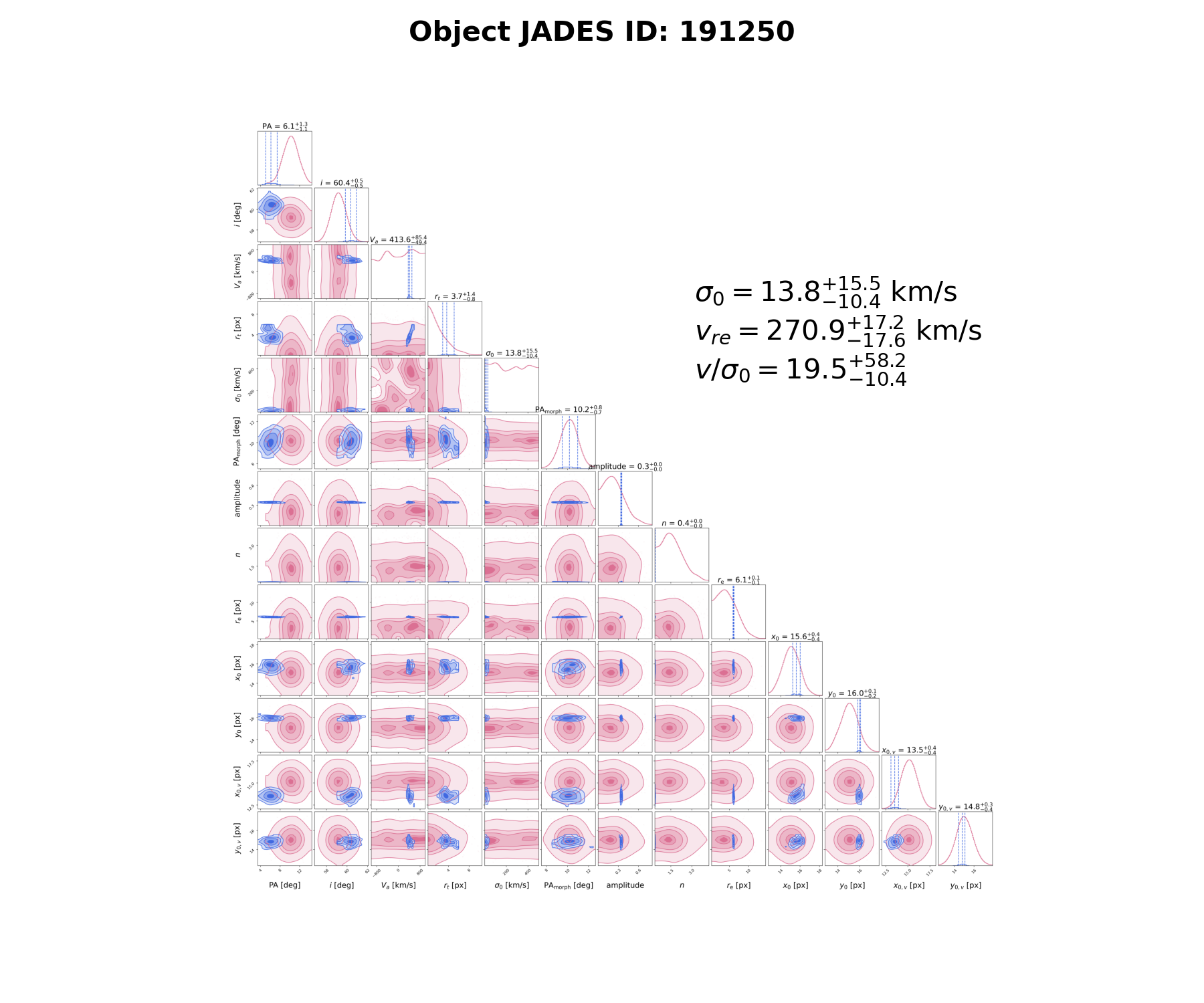
    print("Full Parameter Corner Plot")
    print("=" * 60)
    display(Image(filename=corner_full_plot, width=800))
============================================================
Full Parameter Corner Plot
============================================================
# Create additional diagnostic plots with arviz
print("\n" + "=" * 60)
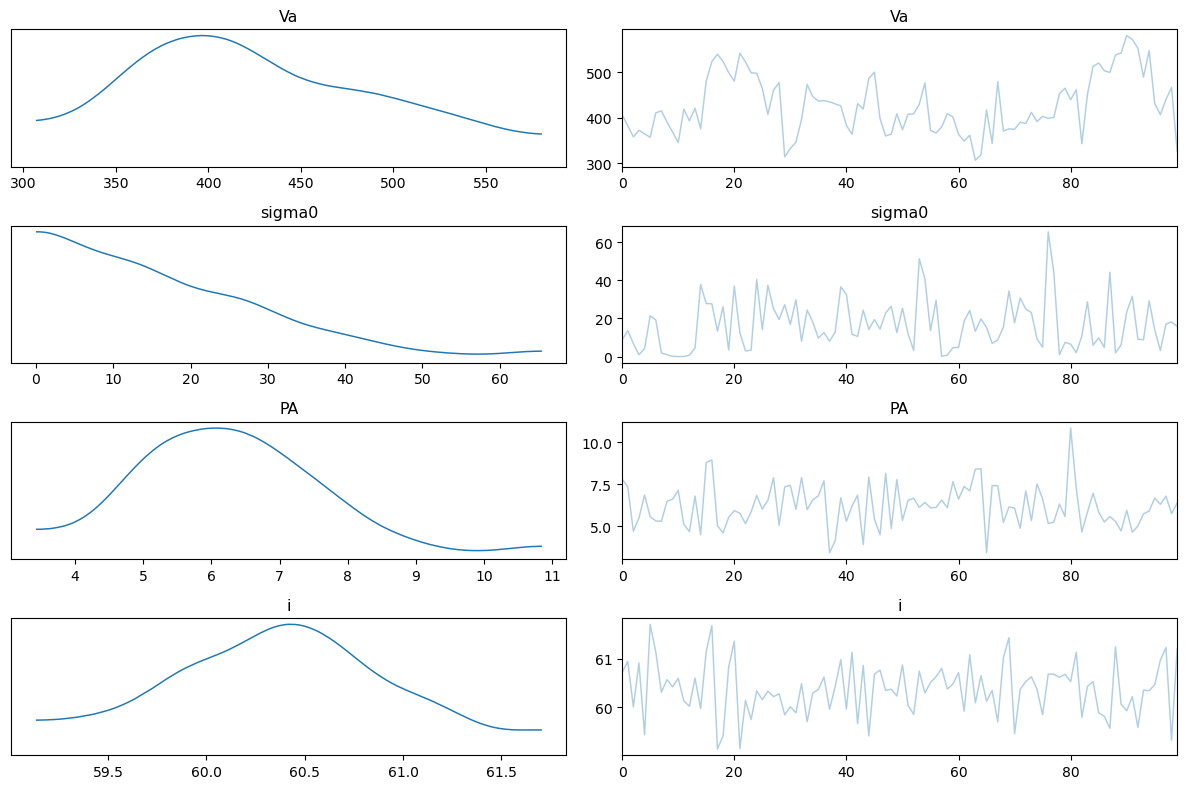
print("MCMC Trace Plots")
print("=" * 60)

# Trace plots for key parameters
az.plot_trace(inference_data, var_names=['Va', 'sigma0', 'PA', 'i'])
plt.tight_layout()
plt.show()
============================================================
MCMC Trace Plots
============================================================
Key Output Parameters#
The most important fitted parameters are:
Kinematic Parameters:
Va: Asymptotic rotation velocity (km/s)sigma0: Central velocity dispersion (km/s)v_re: Rotation velocity at the effective radius (km/s) - derived quantityr_t: Turnover radius (pixels)
Morphological Parameters:
PA: Position angle (degrees)inc: Inclination angle (degrees)r_eff: Effective radius (pixels)n: Sersic indexxc,yc: Centroid coordinates (pixels)amplitude: Flux normalization
Quality Metrics:
r_hat: Gelman-Rubin convergence diagnostic (should be < 1.01)ess_bulk: Effective sample size for bulk of distributioness_tail: Effective sample size for tails of distribution
Advanced: Using Custom Configuration#
You can set custom priors using the FitConfiguration class.
Config contains:
Morphology priors: No defaults - must come from PySersic or manual specification
Kinematic priors: Have defaults but can be overridden
MCMC settings: Have defaults but can be overridden
Scenario 1: You have PySersic fits (typical)
PySersic priors are loaded automatically for morphology
You can optionally provide a config to override kinematic priors (Va, sigma0 ranges)
Morphology stays from PySersic unless you explicitly set it in config
Scenario 2: You don’t have PySersic fits (rare)
You must provide a config with all morphology priors explicitly set
Error will be raised if morphology priors are missing
You can still override kinematic priors if desired
# Example 1: Override kinematic priors (you have PySersic fits)
# Only override the kinematic priors, keep PySersic morphology
from geko.config import FitConfiguration, KinematicPriors

config = FitConfiguration(
    kinematics=KinematicPriors(
        Va_min=50.0,        # Minimum asymptotic velocity (km/s)
        Va_max=300.0,       # Maximum asymptotic velocity (km/s)
        sigma0_min=10.0,    # Minimum velocity dispersion (km/s)
        sigma0_max=150.0    # Maximum velocity dispersion (km/s)
    )
)

# Morphology is None - will use PySersic values automatically
print("Kinematic priors will be overridden, morphology will come from PySersic")
config.print_summary()

# Run fit - PySersic morphology + custom kinematic priors
# inference_data_custom = run_geko_fit(
#     output=output_name,
#     master_cat=master_catalog,
#     line=emission_line,
#     parametric=parametric,
#     save_runs_path=save_runs_path,
#     num_chains=num_chains,
#     num_warmup=num_warmup,
#     num_samples=num_samples,
#     source_id=source_id,
#     field=field,
#     config=config,  # Kinematic override only
#     manual_psf_name=manual_psf_name,
#     manual_theta_rot=manual_theta_rot,
#     manual_pysersic_file=manual_pysersic_file,
#     manual_grism_file=manual_grism_file
# )
Kinematic priors will be overridden, morphology will come from PySersic
Geko Configuration Summary
========================================

Morphology Priors:
  Not set (will use PySersic priors)

Kinematic Priors:
  Va_min: 50.0 (default: -1000)
  Va_max: 300.0 (default: 1000)
  sigma0_min: 10.0 (default: 0)
  sigma0_max: 150.0 (default: 500.0)

MCMC Settings:
  num_chains: 4
  num_warmup: 500
  num_samples: 1000
  target_accept_prob: 0.8
  max_tree_depth: 10
  step_size: 0.1
# Example 2: Complete config with morphology (no PySersic available)
# Set all morphology manually but keep the default kinematic priors
from geko.config import MorphologyPriors

config_full = FitConfiguration(
    morphology=MorphologyPriors(
        # Position angle (degrees) - normal prior
        PA_mean=90.0,
        PA_std=30.0,
        # Inclination (degrees) - truncated normal prior
        inc_mean=55.0,
        inc_std=15.0,
        # Effective radius (pixels) - truncated normal
        r_eff_mean=3.0,
        r_eff_std=1.0,
        r_eff_min=0.5,
        r_eff_max=10.0,
        # Sersic index - truncated normal
        n_mean=1.0,
        n_std=0.5,
        n_min=0.5,
        n_max=4.0,
        # Central coordinates (pixels) - normal
        xc_mean=0.0,
        xc_std=2.0,
        yc_mean=0.0,
        yc_std=2.0,
        # Amplitude - truncated normal
        amplitude_mean=100.0,
        amplitude_std=50.0,
        amplitude_min=1.0,
        amplitude_max=1000.0
    )
)

print("\nComplete config set - can run without PySersic file")
config_full.print_summary()

# This would work even without a PySersic file
# Run fit with complete morphology config
# inference_data_full = run_geko_fit(
#     output=output_name,
#     master_cat=master_catalog,
#     line=emission_line,
#     parametric=parametric,
#     save_runs_path=save_runs_path,
#     num_chains=num_chains,
#     num_warmup=num_warmup,
#     num_samples=num_samples,
#     source_id=source_id,
#     field=field,
#     config=config_full,  # Complete morphology config
#     manual_psf_name=manual_psf_name,
#     manual_theta_rot=manual_theta_rot,
#     manual_pysersic_file=manual_pysersic_file,
#     manual_grism_file=manual_grism_file
# )
Complete config set - can run without PySersic file
Geko Configuration Summary
========================================

Morphology Priors:
  PA_mean: 90.0
  PA_std: 30.0
  inc_mean: 55.0
  inc_std: 15.0
  r_eff_mean: 3.0
  r_eff_std: 1.0
  r_eff_min: 0.5
  r_eff_max: 10.0
  n_mean: 1.0
  n_std: 0.5
  n_min: 0.5
  n_max: 4.0
  xc_mean: 0.0
  xc_std: 2.0
  yc_mean: 0.0
  yc_std: 2.0
  amplitude_mean: 100.0
  amplitude_std: 50.0
  amplitude_min: 1.0
  amplitude_max: 1000.0

Kinematic Priors:
  Va_min: -1000
  Va_max: 1000
  sigma0_min: 0
  sigma0_max: 500.0

MCMC Settings:
  num_chains: 4
  num_warmup: 500
  num_samples: 1000
  target_accept_prob: 0.8
  max_tree_depth: 10
  step_size: 0.1